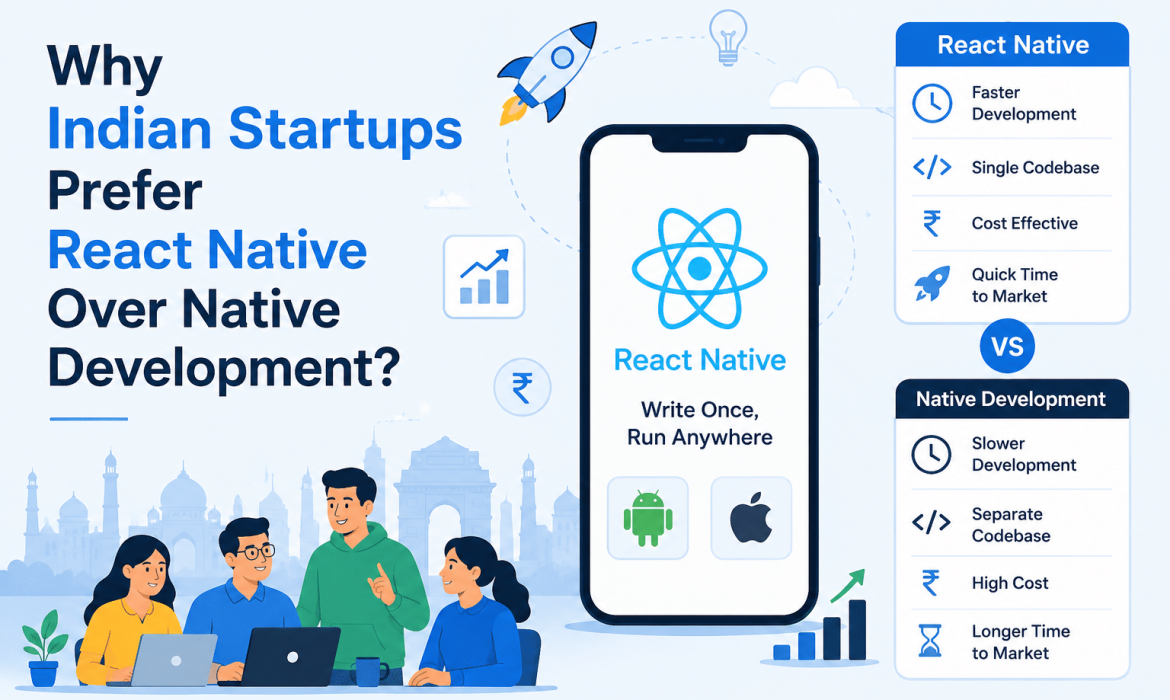
Indian startups are fast. They have few resources. They need apps that run on iOS and Android at the same time. That makes it harder and more expensive because of native development.
That is the reason why many entrepreneurs are choosing React native app development services today. It offers companies one code base to maintain, cuts costs, and reduces time scales. This is not the usual change. Every month, more Indian entrepreneurs are making this sensible choice.
Why Indian Startups are Abandoning Native Development?
Building two separate apps drains the budget fast
Native development requires two code bases. Android Version. One for iOS. So, there are two development teams. Two different rounds of tests. There are two sets of bugs to fix. This is a big problem for a business with little capital. React Native uses a single codebase for both platforms. The savings are substantial and immediate.
Native timelines do not match the startup speed
If it takes an app eight months to release, the company is already behind. Competitors are faster. Markets are changing. Investor interest is fickle. Using React Native can reduce development time by 30 to 40 percent. There is a huge speed advantage. It often separates late launch from on-time launch. React native app development firms enable startups to launch their apps faster, without compromising on features.
Finding skilled native developers in India is harder than people think
Expert Swift developers are expensive. Kotlin experts are in huge demand. A seed-stage business can’t afford to hire both of them. In India, JavaScript developers are easily available and are reasonably priced. React Native is based on JavaScript. This will immediately expand the talent pool and reduce recruiting costs.
Maintaining two codebases creates long-term problems
In native development, every bug fix, feature update, and UI change has to be duplicated. The two code bases diverge over time. There are contradictions. There’s something different for iOS users than for Android users. That is solved with React Native, which centralizes everything. One update covers both systems at the same time.
Investors want quick iterations, not long development periods
The investors in Indian startups want to see rapid growth. They are on the lookout for new products. We expect user input to be incorporated into features quickly. Native development slows that cycle down considerably. React Native continues the momentum. With the help of a react native development company, start-ups can test features, deploy updates, and respond quickly to user behavior.
The ecology and community are developed enough to be dependable
React Native has been in production since 2015. Used for big products by companies like Microsoft, Shopify, and Discord. The ecology of libraries is huge. The neighborhood is lively. Bugs are fixed fast. The documentation is nice. In 2026, a company using React Native is not taking a chance. It’s a matter of picking a proven framework.
Hot reloading speeds up the development process immensely
Developers don’t need to restart the application to see code changes in action immediately. That’s a small problem. Ain’t it so? It removes friction from the development loop. Developers test, fix, and iterate faster. That speed directly correlates to the launch date, which accumulates during a three-month construction cycle.
React Native integrates well with existing web tech stacks
Indian entrepreneurs have plenty of products online already. Their frontend team is comfortable with React, and their backend is working on Node.js. And that current setup is a perfect fit for React Native. There is no technological mismatch. The same team that built the online product can develop the mobile app. This, in turn, reduces the time to onboard and the costs of team coordination.
Why Fixing This Development Approach Is Critical to Startup Growth?
The earlier revenue comes from a quicker app launch
There is no user data on any development week. We haven’t made any money in a week. The competition takes advantage of this week to get a leg up. This gap is bridged with the help of React native app development services. An earlier launch results in early learning. The sooner you learn, the sooner a better product gets to market.
One codebase, one source of truth for your product
The product choices become clearer when you run the same code on both platforms. No feature is unique to one platform and not the other. The User Experience has not changed. Easier to manage the product plan. Founders spend less time on team coordination and more time building the real product.
Lower development costs free up cash for growth
There is still the cost-benefit of a dual native build. Next is marketing or user acquisition, the next feature set. That reallocation of funds is so critical to a business in its first or second year of existence. Development cost-effectiveness is also not a technical choice. The choice is one of progress.
Better developer availability reduces hiring delays
Momentum kills delays in hiring. When a startup can’t find the right developer, it sits idle for weeks. India has a sizable skill pool for React Native. Strong JavaScript communities may be found in places like Bangalore, Pune, Hyderabad, and Delhi. It is far simpler to find a competent React Native development company or individual developer than to find native experts.
Consistent UI across platforms builds user trust
When an Android app differs in appearance from an iOS app, users take note. When a feature functions differently across platforms, they become aware of it. React Native maintains consistency in the user interface. Consistency fosters trust. One platform is not seen by users as an afterthought. Regardless of the equipment, they get the same quality.
Post-launch problems are decreased by simpler testing
It takes less time to test one codebase than two. There are fewer QA cycles. There are fewer post-launch crashes. For startups, this is crucial since a negative debut review on the App Store or Play Store may cause growth to lag by several weeks.
What Should You Consider When Selecting an Indian React Native Partner?
Look through their portfolio
For a healthtech product, a company that has developed e-commerce applications may not be the best choice. Seek out expertise in related fields. Request live applications from the Play Store or App Store. Get them. Put them to the test. More is revealed by the quality of their prior work than by any proposal text.
Find out how they manage UI consistency
There is a useful response to this technical query. A competent React Native development company would have a well-defined procedure for testing the user interface on various screens and devices. It’s a warning sign if they can’t clearly describe that procedure. One of the most frequent concerns about cross-platform applications is UI inconsistencies.
Recognize how they optimize performance
The way the code is written has a significant impact on React Native performance. List rendering, memory management, and lazy loading are all important. Find out how the team handles them. A team that responds incoherently most likely hasn’t worked with a large application. It is good to pay attention to a team that becomes specialized.
To conclude
Indian startups are not switching to React Native because it is trendy. They are switching because it works. It keeps development manageable as the team expands, saves money, and shortens schedules. Get in touch with Geek Informatic & Technologies Pvt. Ltd. if your firm is developing a mobile application and you want it done correctly the first time.
Our staff assists you to hire react native app developer who is qualified for your product, your budget, and your schedule. Reach out now to start the process of developing your app.