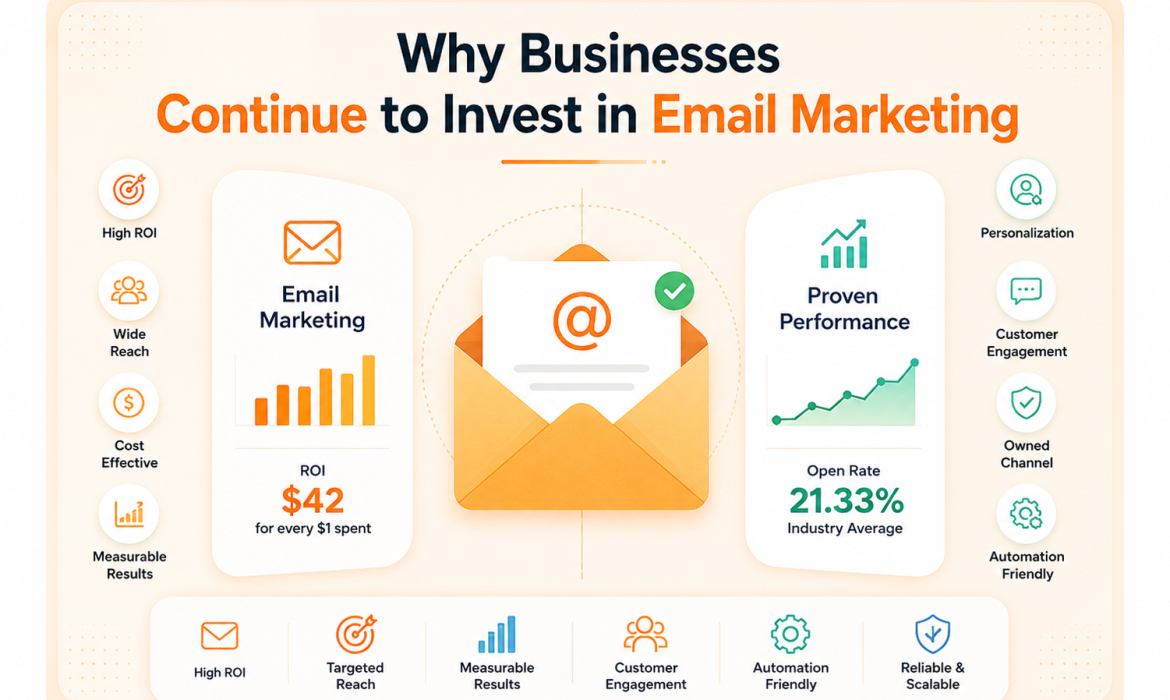
Every few years, someone declares email marketing dead. Every time they are wrong. Email remains one of the highest serving marketing channels for brands of any size. The data backs this up clearly. Brands that invest seriously in email campaigns generate measurable returns that paid social and search rarely match on a cost-per-dollar basis.
Working with a qualified email marketing expert transforms email from a basic broadcast tool into a precision revenue engine. This blog explains exactly why brands keep investing in email and what that investment actually produces.
Email Marketing Continues to Deliver Strong ROI
Return on investment is the clearest reason brands prioritize email marketing. The numbers are not close. Email consistently outperforms other digital channels when you measure revenue generated against dollars spent. There are 4.48B people who use email worldwide as of 2025. This figure reflects real campaign data across industries. They are not theoretical.
Brands that invest in email capture these returns because email lets them reach a subscriber who has already raised their hand. That subscriber opted in. They want to hear from the brand. That intent is something paid advertising can never replicate.
How Owning Your Email List Matters More Than Ever
This is one of the most important distinctions in digital marketing. When you build an audience on social media, you build it on someone else’s platform. Instagram can change its algorithm tomorrow. Facebook can reduce your organic reach overnight. TikTok can get restricted or banned entirely. You have no control over any of that.
Your email list is different. You own it. Nobody can charge you more to reach it. Nobody can deprioritize your content in a feed. When you send an email to your list, it goes directly to the subscriber’s inbox. That direct access is an asset that compounds in value the longer you build it. And here, your email needs to be absolutely precise. For this, you can seek assistance from an email marketing expert.
Brands that learned this lesson early built email lists as a primary strategic priority. Brands that deprioritized email in favor of social platforms found themselves vulnerable every time an algorithm shifted. The ones who invested in email had a stable and owned channel that kept performing regardless of what happened on any third-party platform.
The Platform Dependency Risk
Brands that rely exclusively on social media to reach their audience are one algorithm change away from losing significant reach. An email list gives you an immediate line to your audience that no platform can control or restrict.
How Audience Segmentation Improves Email Performance
One-size-fits-all marketing does not work. Audiences are not homogeneous. A first-time visitor to your website has different needs than a loyal customer who has purchased five times. Sending them the same email treats both poorly.
Email marketing allows brands to segment their audience with precision. You can segment by purchase history. You can segment by the stage of the customer journey that the subscriber currently occupies. Each segment receives content that is specifically relevant to them.
- New subscribers: These are the people who recently signed up for the newsletter or downloaded something. It also includes people who recently created an account or showed interest in your brand. Businesses send welcome e-mails to these users. They do not pitch the product immediately.
- Active buyers: These are the ones who have already purchased and are still using the service or product. E-mail sends to these users because they will buy again, compared to a completely new customer.
- Dormant subscribers: Re-engagement campaigns that use a compelling offer or a direct question to win back attention.
- High-value customers: Exclusive early access to new products. Loyalty recognition that makes top customers feel seen and valued.
- Cart abandoners: Automated sequences that recover revenue from subscribers who left products in their cart without purchasing.
- Post-purchase: Follow-up sequences that build satisfaction, request reviews, and introduce complementary products.
When each segment receives content built specifically for their situation, open rates improve. Click-through rates improve. Revenue per email improves. Segmentation is not a sophisticated extra. It is the baseline for email marketing that actually performs.
How Email Automation Helps Brands Scale Efficiently
Email automation is where the real leverage lives. Automated email sequences run continuously in the background. They trigger based on subscriber behavior. They send the right message at exactly the right moment without any manual intervention required.
A welcome sequence fires the moment someone subscribes. An abandoned cart email sends 30 minutes after a shopper leaves without buying. A post-purchase sequence begins the day after an order ships. A birthday email lands on the subscriber’s actual birthday. A re-engagement campaign triggers after 90 days of inactivity.
These sequences run simultaneously across thousands of subscribers. No team member has to monitor them. No campaign manager has to schedule each send manually. The system handles it. And it handles it at a scale that human execution could never match.
Brands with well-built automation generate revenue from their email list around the clock. Purchases happen at 2 am. Follow-ups land while the team sleeps. The customer journey keeps moving forward regardless of business hours. That 24-hour revenue generation is one of the most compelling arguments for building sophisticated email automation from the start.
Referral Programs Turn Subscribers Into Brand Advocates
Email marketing does more than convert existing subscribers. It activates them as advocates. An email marketing referral program leverages your most engaged subscribers to bring in new ones. This approach significantly reduces customer acquisition costs while delivering prospects who arrive with built-in trust.
The logic is simple. A subscriber who loves your brand and receives consistent value from your emails is primed to recommend you. Give them a structured incentive to do so, and they will. A well-designed referral program embedded in your email marketing flow rewards both the referrer and the new subscriber. Both parties win. The brand acquires a customer at a fraction of the cost of paid acquisition.
An email marketing referral program also produces higher-quality leads than cold advertising does. Referred customers arrive with a personal endorsement already in place. They convert at higher rates. They retain longer. And they are more likely to become advocates themselves over time. This is the compounding effect of building referral mechanics into your email strategy from day one.
Every subscriber you acquire through referral costs you less and performs better than one acquired through paid advertising. Brands that build referral mechanics into their email programs grow their list with higher-quality subscribers at a lower cost per acquisition, month after month.
Conclusion
Email marketing is not a legacy channel holding on for dear life. It is a high-performance revenue tool that brands across every industry continue to invest in because it consistently delivers results that justify that investment. Brands that treat email seriously build an asset that grows more valuable every year.
Ready to make your email work harder for your brand?
Hire an email marketing consultant right away. Geek Tech helps brands build email marketing programs that actually move the needle. We do not just set up a platform and hand you a template. We build a strategy and develop segmentation. Reach out to us today and find out what a properly built email marketing program can do for your business.