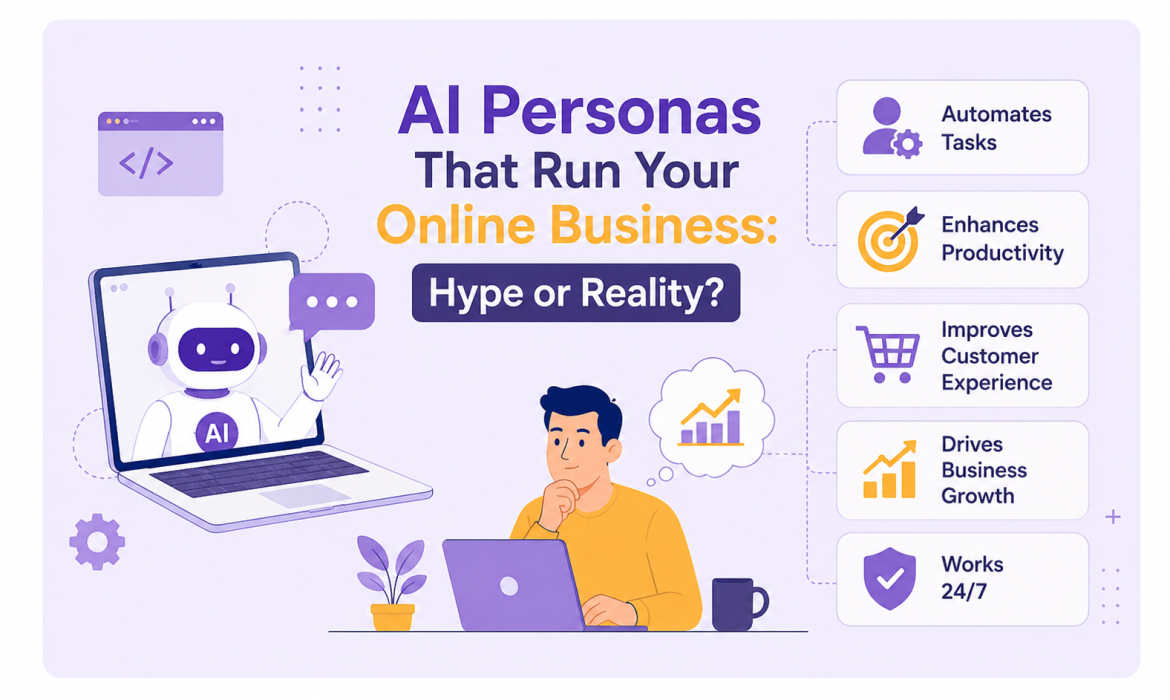
AI Personas That Run Your Online Business: Hype or Reality?
Artificial intelligence now shapes modern online business. Many new tools appear every year. Entrepreneurs experiment with these tools to improve productivity and efficiency. A new concept now receives growing attention. That concept is the AI persona. An AI persona acts like a digital employee that supports daily business tasks. It can answer questions. It can communicate with customers. Many founders now wonder if these systems can go further. Can AI personas run an entire online business?
You should understand what AI personas actually do and what they cannot do yet. This blog explores the reality behind the trend. You will see where AI personas already help businesses. You will also see where human leadership still matters.
By the end, you can decide for yourself. Is AI personas hype? Or are they becoming a real part of online entrepreneurship?
What Are AI Personas?
An AI persona is an artificial intelligence digital identity that fulfills a certain business role. The old software merely performs instructions. The AI personas mimic the human dialogue and interaction. You can consider them the members of virtual teams that help in business. These systems have sophisticated text comprehension language models and produce responses. They do pattern analysis on data and then provide a reply in natural language.
Businesses often assign clear roles to these AI personas. Each persona focuses on a specific responsibility inside the company. This approach helps the system behave more like a specialized employee.
Common examples of AI personas include:
- Customer support assistants who answer common questions
- Marketing assistants who generate content and campaigns
- Social media managers who make posts and engagement suggestions
- Research assistants to collect data and screen wisdom
- Smart email assistants that write emails and sort emails
Each persona is usually characterized by its developer. Other AI assistants talk like friends. Some employ a professional or persuasive voice. The goal is simple. The AI must act as an assistant digital worker. This concept is appealing to most entrepreneurs as it can be scaled to automation. The concept of fully autonomous AI teams, however, poses some key questions.
How AI Personas Already Run Parts of Online Businesses
AI personas already perform many tasks in modern online businesses. Most companies rely on repetitive work that consumes valuable time. AI systems handle many of these tasks efficiently.
- One of the most obvious examples is the customer support. In numerous online shops, AI chatbots are used to respond to common questions. These systems guide customers through simple tasks, such as tracking an order or viewing a product description. They are responsive and spend their entire day.
- Content creation also benefits from AI assistance. Entrepreneurs often use AI tools to generate blog outlines. These systems also help create product descriptions and marketing emails. The goal is not always full automation. The goal often involves faster content production.
- Social media management also benefits from AI personas. These tools suggest post ideas and captions. Some systems even recommend posting schedules based on audience activity.
- AI systems also assist with email management. These digital assistants can organize incoming messages and draft responses. They highlight urgent requests and filter spam messages.
- Sales support also improves through AI. Some systems answer product questions on websites. They guide customers through purchasing decisions. This support helps businesses respond faster to potential buyers.
- Many AI assistants also manage scheduling tasks. They organize meetings and send reminders. They coordinate calendars across different platforms.
These examples show that AI personas already support many daily operations. However, support does not mean full control. Businesses still require human oversight for many important decisions.
Why Businesses Are Interested in AI Personas
Entrepreneurs constantly search for ways to improve efficiency. AI personas promise several advantages that make them attractive business tools. Cost reduction often becomes the first reason companies explore AI. Hiring employees requires salaries and benefits. AI systems usually cost far less. This difference allows small businesses to operate with fewer resources.
Availability also makes AI systems appealing. Human employees need rest and breaks. AI systems operate continuously. They answer customer questions at any hour of the day. Speed also plays a major role. AI systems generate responses quickly. They process large amounts of information within seconds. This speed helps businesses respond faster to customer needs.
Scalability represents another important benefit. When businesses grow, the workload increases. AI systems handle larger workloads more easily than small human teams. Many entrepreneurs also value reduced stress. Running an online business often requires constant attention. Automation tools reduce the pressure created by repetitive tasks.
Business owners often adopt AI personas for several reasons:
- Faster completion of repetitive tasks
- Lower operational costs
- Continuous customer support availability
- Improved productivity across teams
- Easier scaling during business growth
These benefits are the reason why AI tools are rapidly proliferating in the world of online business. Nevertheless, passion in itself is not the assurance of consistency. It is also of great importance to learn the confines of AI.
The Limitations of AI Personas
Notwithstanding the stunning improvements, AI personas continue to have multiple limitations. Such systems are not capable of emulating human thought completely. The judgment of a human being is still hard to duplicate. Difficult scenarios demand emotional intelligence and situational knowledge. In these situations, AI systems are not always up to the task.
Customer service interactions clearly demonstrate this challenge. Some customers describe complicated issues. AI responses may misunderstand the request and generate incorrect answers. This experience can frustrate customers. Creativity also presents challenges. AI tools generate content based on existing patterns. They analyze large datasets and produce new combinations. However, truly original ideas still benefit from human creativity.
Strategic decision-making also remains a human strength. Business strategy requires a deep understanding of markets and competition. AI systems analyze data, but they cannot fully understand market dynamics. Ethical concerns also require attention. AI systems sometimes produce inaccurate information. Bias within training data can also influence responses. Privacy concerns also affect many businesses. AI tools often process sensitive customer information. Companies must protect this data carefully.
Businesses should remember several limitations when using AI personas:
- Limited human judgment in complex situations
- Occasional incorrect or misleading responses
- Weak strategic thinking capabilities
- Potential data privacy concerns
- Dependence on external technology platforms
These challenges explain why AI rarely operates without supervision. Human oversight remains essential for responsible business operations.
Can AI Run an Entire Online Business?
The central question remains important. Can AI operate an entire online business without human involvement? The answer today remains mostly no. AI systems successfully automate many routine tasks. However, they still require human leadership and supervision.
AI performs well in areas such as content generation and customer support. It also assists with research and scheduling. These tasks rely on pattern recognition and structured responses. Running a business involves more complex responsibilities. Entrepreneurs must create strategies and evaluate risks. They must study market changes and adjust quickly.
Brand development also requires human creativity. Successful brands build emotional connections with customers. Authentic storytelling plays a major role in brand identity. Innovation also requires experimentation. Founders often test new ideas and adapt quickly. AI systems struggle with this level of creative exploration.
Most successful companies now adopt a hybrid approach. Humans guide strategy and long-term direction. AI tools support daily operational tasks. This collaboration creates efficiency without removing human leadership. AI becomes a powerful assistant rather than a complete replacement.
The Future of AI Personas in Online Business
AI technology continues evolving rapidly. New capabilities appear every year. Future AI personas will likely become far more sophisticated. Improved reasoning abilities may help AI provide better decision support. Advanced language models may improve communication quality with customers. Automation systems will likely integrate across multiple platforms. These systems could coordinate marketing campaigns and analyze customer behavior.
Future AI assistants may perform tasks such as:
- Managing digital marketing campaigns
- Monitoring sales performance
- Analyzing customer trends
- Recommending product improvements
These capabilities could transform online entrepreneurship. Small teams may manage larger businesses with fewer resources. However, human leadership will still guide long-term direction. Entrepreneurs will define company values and strategic goals. Technology performs best when humans guide its purpose. The future is likely to see closer collaboration between humans and AI systems. Each will contribute different strengths to the business environment.
Conclusion
AI personas represent one of the most interesting developments in modern online business. These digital assistants already perform many useful tasks. They generate marketing content. They assist with scheduling and communication. These capabilities improve productivity and reduce repetitive workload. However, AI personas cannot fully replace human leadership. Strategy and creativity still require human insight. Successful businesses still rely on entrepreneurial vision. AI personas, therefore, represent neither pure hype nor complete replacement. They represent powerful tools that support modern businesses. Entrepreneurs who use these tools wisely gain a significant advantage. The smartest companies combine human creativity with AI efficiency. AI personas will not replace entrepreneurs. They will help them build stronger and more efficient companies.

A Step-by-Step Guide to Improving Facebook Engagement in Minutes
Are you struggling to get likes, comments, and shares on your Facebook posts? You are not alone. Many businesses and individuals find it challenging to keep their audience engaged. The good news is that boosting Facebook engagement does not have to be complicated. With a few simple steps, you can attract more interactions and keep your followers interested. In this blog, you will learn practical ways to improve your engagement and make your content stand out on Facebook. So, let’s get started.
What Facebook Engagement Means and Why It Matters
Before checking out the strategies, you need to understand what Facebook engagement actually means so that you can create content with a clear vision. Facebook engagement helps you to connect with a wider audience. Not only this, it also provides an opportunity to showcase and promote your content and generate revenue from it. The basic steps to understand the Facebook engagement you to keep an eye on below matrics:
- Likes
- Comments
- Shares
- Other interactions on your posts (reactions, saves, profile visits, etc).

By analyzing these engagement metrics, you can learn what your audience is interested in, what they like, and what brings them back to your page or post. High engagement shows that your content is connecting with your audience, and it gives insight into what type of content is performing well and what content needs improvement. When people engage with your Facebook algorithm, they prioritize you over other competitors. Higher engagement increases your reach, helps build a loyal audience, and can even boost sales if you use Facebook for business.
Here are the Steps You Need to Take for Better Facebook Engagement
Know Your Audience and Content
It is important to understand the viewing preference of your audience. This will help you create relevant content for them. Also, you need to understand your niche in depth. When you combine these two things, you’ll create fresh and engaging content that people will want to see. It can give your content a real chance of going viral or trending.
Furthermore, understanding your audience is the first step to better Facebook engagement. Who follows your page? What kind of content do they like? You need to find answers to these questions. Use Facebook Insights to see which posts get the most engagement. Once you know what content works, create more of that kind of content.
Post Quality Content and Eye-catching Visuals
Next, you always need to post quality content. It will maintain your page or brand reputation. People scroll through their Facebook feeds quickly, so your content must grab their attention. Use high-quality images, videos, and graphics to make your posts stand out. The more engaging your content is, the more likely it is that your posts will get more engagement.
For eye-catching content, short video content is particularly powerful. Short, engaging videos tend to get more interactions than text-only posts. Use captions to make videos accessible to all audiences. Infographics and carousel posts also work well to keep users engaged. Adding a mix of different visual formats keeps your page interesting and leads to more reactions and shares.
Write Short and Catchy Captions
Nowadays, the patience of the audience has become very short. Very few people read all the captions of any post, and long captions can bore your audience. You need to keep your captions short and interesting to grab the attention of the audience. Ask questions, add humor, or use emojis to make your text interesting. A catchy caption can encourage people to respond or leave a comment.
Using action words in captions encourages users to take part in the conversation. Instead of saying, “New product available now,” say, “Try our latest product and tell us what you think!” This small change invites people to interact. Adding urgency or exclusivity, such as “Limited stock – get yours today!” can also boost engagement.
Follow our Web Stories for more updates on Digital Marketing!
[web_stories title=”true” excerpt=”false” author=”false” date=”false” archive_link=”true” archive_link_label=”” circle_size=”150″ sharp_corners=”false” image_alignment=”left” number_of_columns=”1″ number_of_stories=”20″ order=”DESC” orderby=”post_title” view=”carousel” /]
Post Your Content When Your Audience is Active
It is very difficult to solve this mystery because whenever a user logs in to his Facebook account, he sees thousands of new feeds on his screen. People follow many pages and accounts, so competition to be at the top of the feed is very high.
But don’t worry! There is a solution to this mystery. Check your Facebook Insights to see when your audience is most active and post your content only at that time. Posting when they are online increases visibility and helps increase engagement on social media platforms.
Ask Your Audience Questions
Every person wants to share their thoughts. The easiest way to create engagement with your audience is to ask questions. Ask questions like “What activity do they like to do on the weekend?” or “Which product do you prefer?”. When people respond, you should continue the conversation through response comments.
Also, question-based posts create a sense of community. They encourage followers to share personal experiences, making your page feel more interactive. Polls and “this or that” questions also work well in grabbing attention. When your audience sees you value their input, they will be more likely to continue engaging with your content.
Keep Your Profile Up-to-Date
An outdated profile can make you lose credibility. Regularly update your profile picture, cover photo, and bio. Make sure your contact details and links are correct. A well-maintained profile makes your page look more professional and trustworthy.
Use your bio to tell your audience what your page is about and why they should follow you. Keep it simple but informative. Having a pinned post with important updates or links to your latest content helps keep new visitors informed and engaged with your page.
Create Trendy & Relevant Content in Your Industry
Stay updated with the latest trends in your industry. Share current information about your content field, viral challenges, or trending topics that relate to your audience. Trendy content is more likely to be shared by people, and it solves your problem of how to get more engagement on Facebook easily.

People enjoy content that feels timely and relevant. If there is a trending meme or event related to your industry, create content around it. However, make sure it aligns with your brand voice. Trendy content should feel natural rather than forced to maintain authenticity.
Go Live and Interact with Your Audience
Facebook Live is a powerful tool for engagement. Live videos allow you to connect with your audience in real-time. Host Q&A sessions, product launches, or behind-the-scenes content. Live interactions encourage viewers to comment and engage with you directly.
Announce your live sessions in advance to build anticipation. Encourage viewers to ask questions during the stream. Engaging in real-time conversations helps strengthen relationships with your followers. The more interactive your live video is, the more likely it is to get shared and recommended to others.
Check our another blog on Facebook Marketing Strategy
Maximize Your ROI: The Importance of a Facebook Ad Expert in Your Marketing Strategy
Engage, Grow, and Succeed on Facebook
When you implement the right strategies, you will see improvements in your audience interactions. Whether you are a business or an individual, staying active and consistent is the key to how to improve Facebook engagement over time. So, start implementing the above-mentioned steps today, and watch your engagement grow!
If you want additional help, reach out to experts by partnering with Geek Informatic & Technologies Pvt. Ltd. today. We provide solutions to all individuals or businesses by improving their engagement rate on social media.