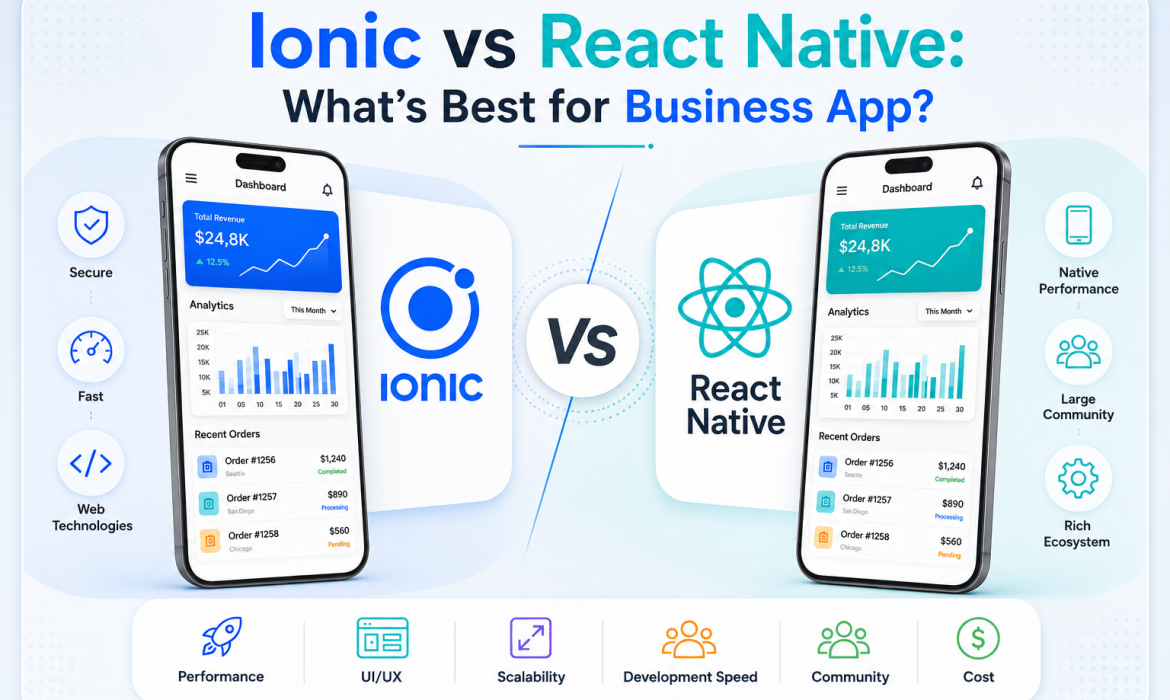
Ionic vs React Native: What’s Best for Business App?
You are building a business app in 2026. You have two strong options in front of you. Ionic and React Native both deliver cross-platform apps from a single codebase. Both are trusted. Both are production-ready. But they solve the problem differently. Choosing the wrong one costs you time. It costs you money. It can cost you your users. Before you pick a framework, you need to understand what each one actually does for your business. This blog breaks it down simply and honestly. If you are looking for ionic app development services or evaluating React Native for your next project, this is where to start.
The Core Difference Between Ionic and React Native
Ionic is a hybrid framework. Your app runs inside a WebView. Think of it as a browser embedded inside a native shell. You write HTML. You write CSS. You write JavaScript. The result works on iOS. It works on Android. It works on the web. It even works on a desktop. Ionic today runs on Capacitor 8. That replaced the old Cordova runtime. Capacitor brings more direct access to native APIs. It also supports Swift Package Manager on iOS and edge-to-edge layouts on Android.
React Native takes a completely different path. But React Native does not render a web page. It renders real native UI components. The buttons look native. The scroll behavior feels native. As of 2025, React Native ships the New Architecture by default. The old async bridge is gone. JSI now handles direct synchronous calls to native code. Fabric handles UI rendering. The result is near-native performance.
Hybrid / WebView
- Runs inside an embedded browser
- Works with React, Vue, or Angular
- iOS + Android + Web + Desktop
- Capacitor 8 replaces Cordova
- Fastest path for web teams
Native UI rendering
- Renders real native components
- React + JavaScript / TypeScript
- iOS + Android (Expo expands this)
- New Architecture: bridge removed
- OTA updates via Expo EAS
How Fast Are Ionic and React Native in Real Apps?
- React: React Native’s New Architecture removed its biggest bottleneck. Synchronous native calls are now possible. UI rendering is faster. For apps with complex animations, this matters a lot. For apps with real-time data feeds, this matters. For apps that use the camera or Bluetooth, this matters.
- Ionic: Ionic’s performance is entirely acceptable for most business apps. Internal dashboards run fine. Form-heavy workflows run fine. Customer portals run fine. Inventory tools run fine. The WebView ceiling only becomes visible in specific high-performance scenarios. If your app does not hit those scenarios, Ionic performs well enough that the architecture stops being a liability.
For standard enterprise use cases, working with a skilled Ionic mobile app development company will get you a fast and reliable product. The framework is not the bottleneck. The implementation quality is.
How Fast Can You Build with Each Option?
- Ionic: Ionic meets your web team where they already are. If your developers know React, Vue, or Angular, they can build in Ionic immediately. There is no context switch to mobile paradigms. You reuse existing components. You reuse your CSS. You reuse your testing setup. Development speed is genuinely faster for web-first teams.
- React: React Native requires thinking like a mobile developer. You write React. But you target native component trees, not a browser DOM. The learning curve is real. It is manageable for experienced React developers. But it adds time at the start. Expo’s tooling has reduced much of the setup pain. Cloud builds, over-the-air updates, and file-based routing via Expo Router now come standard.
The practical question is simple. Does your team already write web code every day? Start with Ionic. Does your team already know React, and you need a mobile-first product? React Native is the stronger long-term foundation.
When to Choose Ionic
Your app is content-driven. Your app is form-heavy. You need the same experience on the web and on mobile. You want to ship to iOS, Android, and the browser from one codebase. Your team has strong web skills and no native mobile background. Your budget is tight, and your timeline is short.
Companies like T-Mobile, Volkswagen, and Disney have used Ionic for internal and customer-facing tools. One developer reported saving over $200,000 in build costs by using web skills through Ionic instead of going native.
If any of those scenarios describe your project, ionic app development is a serious and well-proven path. It is not the “cheaper” option. It is the smarter option for the right kind of app.
When to Choose React Native
Consumer-facing apps in fintech, health, e-commerce, or social platforms need a UI quality that a WebView cannot always deliver. Real-time apps need synchronous performance. Apps with complex device integrations need deep native access. If your users pay for and install apps from the App Store or Google Play, the native experience directly affects retention.
React Native also wins when you need over-the-air updates. Expo’s EAS lets you push code changes to users without waiting for App Store review. That is a significant operational advantage. For teams shipping fast, that alone can justify the choice.
Partnering with a quality team is essential here. An experienced ionic app development company knows how to push the framework to its limits. The same is true for React Native. Framework choice and execution quality are both part of the equation.
Bottom Line
Both frameworks are production-grade in 2026. Neither is going away. Ionic’s community is active. Capacitor 8 keeps its current. React Native’s New Architecture is its biggest leap since 2015. The comparison is valid. But it is a starting point, not a conclusion. Ask yourself three questions before you decide. What does my team already know? Does this app’s success depend on native UI quality? What platforms do I need to reach? Answer those honestly. The right framework becomes obvious.
At Geek Informatic & Technologies Pvt. Ltd., we help businesses choose the right framework. We build high-quality apps and scale them with the right digital strategy. Book a call, and let’s build amazing apps together.