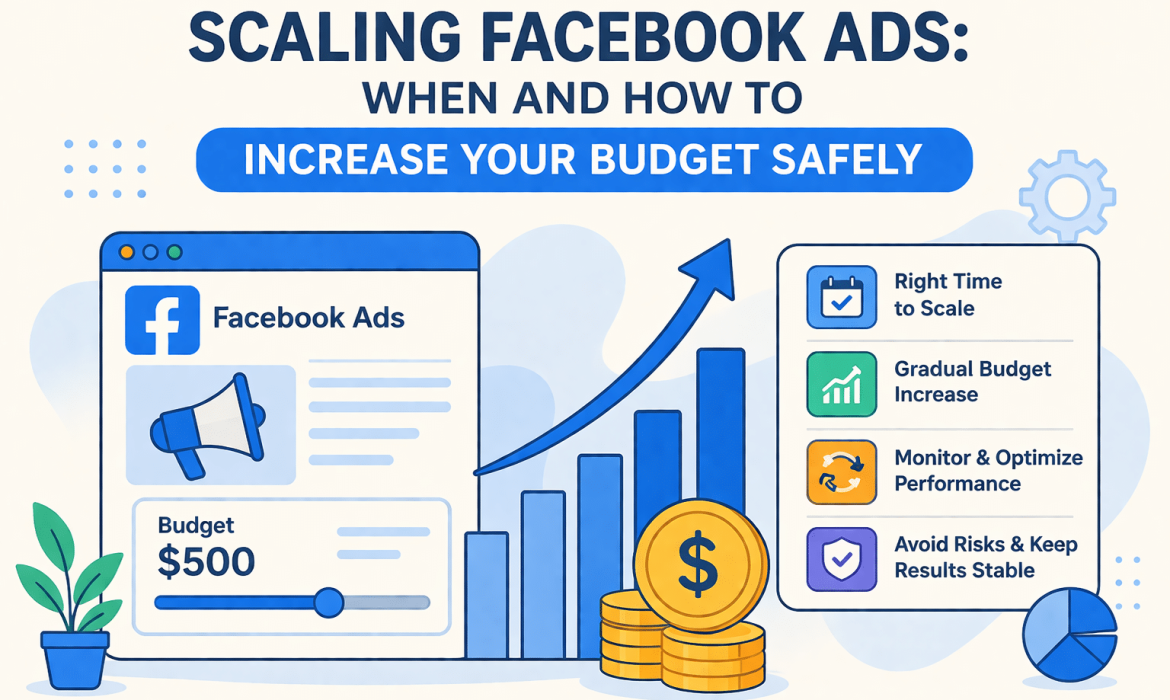
Scaling Facebook Ads: When And How To Increase Your Budget Safely
Are Facebook ads working for you? That’s great, but the real challenge is growing without hurting performance. Many businesses increase their budgets in the hopes of getting more leads, but this only leads to higher costs and worse results.
So, how do you properly grow your ads? This article will teach you when to scale, how to do it safely, and what strategies really work to improve your performance without costing you a lot of money. This advice is also used by many of the best Facebook ads experts.
When Is The Right Time To Scale Facebook Ads?
When you can trust the results of your campaign
One of the best signs that you’re ready to grow your Facebook ads is that they keep working. This means that your ads are getting consistent results over several days, not just one good day. You should look at things like cost per lead, conversion rate, and return on ad spend.
If these numbers stay the same and are within your goal range for at least three to five days, your campaign won’t depend on luck. Instead, it is based on a good plan. Scaling at this point is safer because you are building on known results instead of trying out new ones.
When Your Ads’ Learning Phase Is Over
When Facebook ads are in the learning phase, the system looks at different places and groups of people to see what works best. During this time, Facebook ads specialists believe that performance may be unstable and hard to predict. At this point, scaling could confuse the algorithm and hurt your results.
It’s time to scale when your ads have moved from the learning phase to a stable state. Facebook now has enough information to properly send out your ads. Instead of starting over, scaling beyond this point lets you grow your campaign without losing performance.
When Your Results Are Making Money or Almost Making Money
You should only scale up when your ads are already making you money or almost making you money. If you’re still losing money or just barely making ends meet, raising the budget will only make your losses worse. Instead, you should start by making your campaign as effective as possible until the cost per result is reasonable.
When your ads start to bring in money or have a good chance of doing so, that’s when you should grow them. This makes your growth safer and more sustainable for your business because it ensures that every extra dollar you spend has a better chance of making money.
Understanding Facebook Ads Learning Phase Before Scaling
The Role of Data Volume in the Learning Phase
The learning phase is mostly based on how much data your campaign can collect. Facebook needs a lot of user activity, like clicks or conversions, to figure out who is most likely to respond to your ads. If your campaign doesn’t give the algorithm enough data, it can’t optimize distribution very well.
This happens a lot when the budget is too small or the audience is too small. Instead of rushing to grow, you should focus on improving data flow. Strong data signals in a campaign help you target better, which makes it easier and more efficient to scale up without performance drops.
Why it’s important to track conversions accurately before scaling
Facebook uses this data to improve your campaign, so it’s very important to keep an eye on it during the learning phase. If your tracking setup is wrong or missing, the system learns from false signals. Even if your ads look good, this means they don’t reach the right people and don’t work well.
Before you grow, make sure that things like sales, leads, or sign-ups are recorded correctly. You need to set up tools like Conversion API and Facebook Pixel the right way. This is also done by Facebook ads specialists. When your data is clean and reliable, Facebook can make better decisions, and your campaign will be strong enough to handle growth without taking unnecessary risks.
Vertical Scaling Vs Horizontal Scaling: What’s The Difference?
The main difference between vertical and horizontal scaling is how you grow your reach and results. Vertical scaling is all about getting more money for the same campaign, while horizontal scaling is all about getting more setups to help the campaign grow. Vertical scaling is faster, but it can be dangerous if you don’t pay attention.
Horizontal scaling is slower but more reliable because it spreads the risk across many campaigns. Control is another difference: vertical scaling is based on how well things are going right now, while horizontal scaling gives you more options for testing. To find a good balance between growth, stability, and long-term performance, good ads often use both methods.
Common Scaling Mistakes That Cost You Money on Ads
Too quickly raising the budget
One of the most common mistakes is to raise the budget too quickly. When marketers see good results, they often get excited and suddenly spend more or three times as much. Facebook’s technology is confused by this because it needs to find a much larger audience quickly. As a result, performance goes down, costs go up, and conversions become less predictable.
Scaling should always be done slowly so that the system can adapt without any problems. When you speed up the process, you lose control over how efficient and targeted it is. A slow growth may not seem as exciting, but it protects your campaign and helps keep results stable over time.
Not paying attention to how tired the audience is
Facebook ads specialists say that when the same people see your ads too many times, they get tired of them. When you grow without changing your ads or getting more people to see them, people start to ignore them. This leads to fewer clicks and higher costs per result. A lot of marketers don’t pay attention to this problem and keep spending more money on the same group of people, which makes things worse.
To stop this from happening, you need to keep an eye on how often and how much people are involved. If your performance starts to drop, your audience is getting tired. You can keep people’s interest and your campaign running smoothly while scaling by updating your creatives or focusing on new audiences.
Making campaigns that don’t work bigger
Another big mistake is trying to scale campaigns that aren’t working well. If your ads are already getting bad or inconsistent results, raising the budget could just make your losses worse. Scaling doesn’t fix problems; it makes them worse. Before you raise your budget, make sure your offer, creatives, and targeting are all working.
By now, your campaign should be getting results that are steady and good. Scaling only makes sense then. If you skip this step, you’ll be angry and lose money. A solid foundation is important for scaling to work best, so it’s best to build on something that has already been shown to work well.
In the end
Increasing your budget is only one part of scaling Facebook ads. What else is included in it? Always remember that timing, method, and strategy are also important. You need to understand the learning phase and know how to choose the right scaling strategy. Also, you need to avoid the common mistakes.
We, Geek Informatic & Technologies Pvt. Ltd., put data-driven, smart scaling methods that work at the top of our list. If you want to safely and effectively grow your Facebook ads, our staff is ready to help you at every step. Let’s work together to grow your business the right way. We are the best FB ads agency.