Content Clusters for SEO: How to Boost Rankings Fast
Many websites publish blogs every week. They expect search rankings to grow quickly. However, many blogs fail to attract steady organic traffic. The reason is simple. Many websites publish isolated articles without a clear strategy. Each post targets a different topic. Each post stands alone without connection to other content.
Search engines now evaluate websites differently. Google no longer ranks pages based only on individual keywords. Google now evaluates topic authority across an entire website.
Websites that cover a subject deeply gain stronger visibility. Websites that publish random articles often struggle to rank.
This shift changed modern SEO strategies. Marketers now focus on structured content systems instead of random blogging.
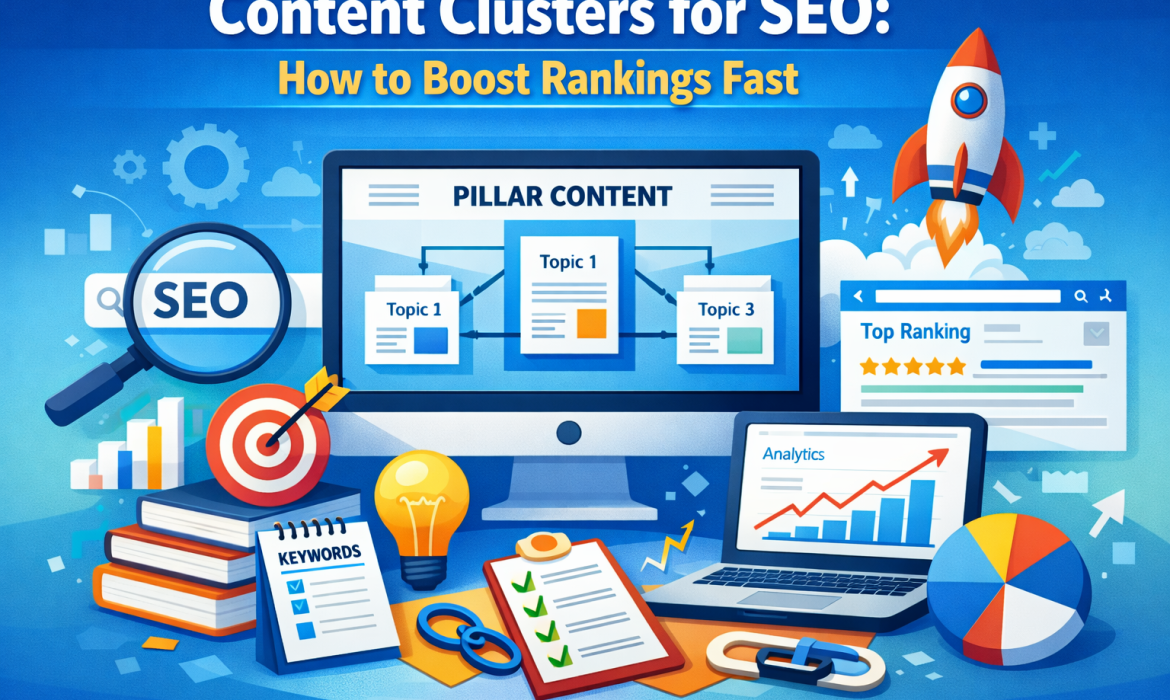
One powerful system is the content cluster model. This approach organizes articles around one main topic. Each article connects to related pages through internal links.
This structure helps search engines understand your expertise. It also helps readers explore information easily.
Businesses that implement content clusters often improve rankings faster. They also build long-term authority in search results.
The Core Idea Behind Content Clusters and Topical Authority
Content clusters organize multiple articles around a central topic. This structure signals strong subject expertise to search engines.
A content cluster contains three essential elements.
The first element is the pillar page.
The second element is supporting cluster articles.
The third element is internal linking.
The pillar page covers the main topic broadly. It introduces the subject and provides an overview.
Cluster articles explore smaller subtopics in greater detail. Each article answers specific questions related to the main subject.
Internal links connect all pages within the cluster. These links create a clear topic network.
Search engines analyze these connections carefully. They use them to understand the relationship between pages.
When multiple pages cover one subject thoroughly, search engines recognize strong topical authority.
This authority increases the chances of ranking for competitive keywords.
Websites that build strong topic clusters often outperform competitors who publish scattered articles.
How Content Clusters Help Search Engines Understand Your Website
Search engines constantly analyze how websites organize information. They look for signals that indicate expertise and structure.
Internal links play an important role in this analysis. They help search engines identify relationships between pages.
Content clusters create a clear hierarchy.
The pillar page acts as the central resource.
Cluster articles support the main topic.
Search engines recognize the pillar page as the primary authority page. They view supporting articles as detailed resources.
This hierarchy makes the website easier to understand.
Search engines also crawl clustered websites more efficiently. Clear linking structures guide search bots through related content.
Readers benefit from this structure as well. They can easily move between connected topics.
When visitors stay longer on a website search engines interpret this behavior as a positive signal.
These signals often contribute to improved search rankings.
Pillar Pages: The Foundation of Every Content Cluster Strategy
Every content cluster begins with a pillar page. The pillar page targets a broad topic that relates to your business or audience.
This page provides a comprehensive overview of the subject. It explains the key concepts and introduces related ideas.
A pillar page usually contains long form content. Many pillar pages exceed two thousand words.
The page should answer major questions about the topic. It should also guide readers toward more detailed articles.
These detailed articles form the supporting cluster content.
Think of the pillar page as a central hub of information. Supporting articles extend the knowledge beyond the main page.
For example consider a pillar page about content marketing.
Supporting cluster articles might include:
- Content marketing strategy
- Blog writing techniques
- Content promotion methods
- Content performance measurement
Each article explores one specific aspect of the topic.
The pillar page links to these articles. Each article also links back to the pillar page.
This linking system strengthens the topic network.
Building Supporting Content That Strengthens the Cluster
Supporting cluster articles form the backbone of the content cluster strategy.
Each article should focus on a single subtopic related to the main pillar page.
Cluster articles should answer specific search questions. They should also provide deeper explanations than the pillar page.
For example consider a pillar page focused on SEO strategy.
Cluster articles could include topics such as:
- Keyword research methods
- On page optimization techniques
- Link building strategies
- Technical SEO fundamentals
Each article targets a specific search intent. This improves the chances of ranking for long tail keywords.
Cluster articles must also connect through internal links.
Every cluster article should link back to the pillar page. This link signals that the pillar page remains the central authority.
Cluster articles may also link to other related articles.
This network creates a strong topic ecosystem. Readers can move between related subjects easily.
This behavior improves engagement and increases page views.
Search engines interpret this interaction as strong content relevance.
Step by Step Process to Create an Effective Content Cluster
Creating a content cluster requires planning and research. The process becomes easier when you follow a clear structure.
Step 1: Identify a Core Topic
Choose a broad topic that relates to your business. The topic should also match the interests of your target audience.
Examples include digital marketing. Content marketing. Search engine optimization.
Step 2: Research Supporting Keywords
Look for search queries related to the core topic. Keyword tools and search suggestions can help identify these ideas.
Group similar keywords into topic categories.
Each group can become a future cluster article.
Step 3: Build a Comprehensive Pillar Page
Create a detailed guide that explains the main topic clearly.
This page should introduce major concepts. It should also link to deeper supporting articles.
Step 4: Develop Supporting Cluster Articles
Write separate articles that explore each subtopic.
Each article should answer one specific question.
Focus on depth and clarity.
Step 5: Connect Everything Through Internal Links
Link the pillar page to every cluster article.
Link cluster articles back to the pillar page.
This linking system creates a structured content network.
Over time this structure strengthens your SEO authority.
Common Content Cluster Mistakes That Hurt SEO Performance
Many websites attempt content clusters but make critical mistakes.
One common mistake involves choosing topics that are too broad. Broad topics make clusters difficult to organize.
Another mistake involves weak internal linking. If cluster pages do not connect properly the structure loses effectiveness.
Some websites publish very short articles. Thin content provides little value to readers.
Search engines prefer detailed and helpful content.
Another mistake involves repeating similar information across articles. Duplicate ideas weaken the authority of each page.
Some websites ignore user search intent. They focus only on keywords instead of answering real questions.
Strong clusters solve real problems for readers.
Avoiding these mistakes helps the cluster strategy succeed.
Example of a Simple Content Cluster Structure
A simple example can help illustrate the concept.
Imagine a website that focuses on digital marketing.
The pillar page might cover the topic of digital marketing strategy.
This page introduces the major concepts of online marketing.
Supporting cluster articles might include topics such as:
- Content marketing strategy
- Email marketing fundamentals
- Social media marketing techniques
- Search engine optimization basics
Each article explores its topic in greater depth.
The pillar page links to every cluster article.
Each cluster article links back to the pillar page.
This structure creates a strong internal network.
Search engines easily recognize the main topic.
Readers can also explore related information without confusion.
Conclusion: Why Content Clusters Are Essential for Modern SEO
Search engine optimization continues to evolve. Random blogging strategies no longer deliver strong results.
Search engines now reward structured content systems. Content clusters provide one of the most effective systems available.
This approach organizes content around clear topics. Pillar pages introduce the subject broadly. Supporting articles explore detailed subtopics.
Internal links connect all pages within the cluster.
This structure helps search engines understand your website expertise. It also improves navigation for readers.
Businesses that adopt content clusters often see stronger rankings. They also experience steady growth in organic traffic.
If you want to improve your SEO results start building topic clusters today. Plan your pillar pages carefully. Create helpful supporting articles.
Connect your content through clear internal links.
Over time your website will build stronger authority and achieve higher search visibility.

AI PersonasPersonas That Run Your Online Business: Hype or Reality?
Artificial intelligence now shapes modern online business. Many new tools appear every year. Entrepreneurs experiment with these tools to improve productivity and efficiency. A new concept now receives growing attention. That concept is the AI persona. An AI persona acts like a digital employee that supports daily business tasks. It can answer questions. It can create content. It can communicate with customers. Many founders now wonder if these systems can go further. Can AI personas run an entire online business?
You should understand what AI personas actually do and what they cannot do yet. This blog explores the reality behind the trend. You will see where AI personas already help businesses. You will also see where human leadership still matters.
By the end, you can decide for yourself. Is AI personas hype? Or are they becoming a real part of online entrepreneurship?
What Are AI Personas?
An AI persona is an artificial intelligence digital identity that fulfills a certain business role. The old software merely performs instructions. The AI personas mimic the human dialogue and interaction. You can consider them the members of virtual teams that help in business. These systems have sophisticated text comprehension language models and produce responses. They do pattern analysis on data and then provide a reply in natural language.
Businesses often assign clear roles to these AI personas. Each persona focuses on a specific responsibility inside the company. This approach helps the system behave more like a specialized employee.
Common examples of AI personas include:
- Customer support assistants who answer common questions
- Marketing assistants who generate content and campaigns
- Social media managers who make posts and engagement suggestions
- Research assistants to collect data and screen wisdom
- Smart email assistants that write emails and sort emails
Each persona is usually characterized by its developer. Other AI assistants talk like friends. There are those who employ a professional or persuasive voice. The goal is simple. The AI must act as an assistant digital worker. This concept is appealing to most entrepreneurs as it can be scaled to automation. The concept of fully autonomous AI teams, however, poses some key questions.
How AI Personas Already Run Parts of Online Businesses
AI personas already perform many tasks in modern online businesses. Most companies rely on repetitive work that consumes valuable time. AI systems handle many of these tasks efficiently.
- One of the most obvious examples is the customer support. In numerous online shops, AI chatbots are used to respond to common questions. These systems lead the customers through easy problems like tracking the order or the product description. They are responsive and spend their entire day.
- Content creation also benefits from AI assistance. Entrepreneurs often use AI tools to generate blog outlines. These systems also help create product descriptions and marketing emails. The goal is not always full automation. The goal often involves faster content production.
- Social media management also benefits from AI personas. These tools suggest post ideas and captions. Some systems even recommend posting schedules based on audience activity.
- AI systems also assist with email management. These digital assistants can organize incoming messages and draft responses. They highlight urgent requests and filter spam messages.
- Sales support also improves through AI. Some systems answer product questions on websites. They guide customers through purchasing decisions. This support helps businesses respond faster to potential buyers.
- Many AI assistants also manage scheduling tasks. They organize meetings and send reminders. They coordinate calendars across different platforms.
These examples show that AI personas already support many daily operations. However, support does not mean full control. Businesses still require human oversight for many important decisions.
Why Businesses Are Interested in AI Personas
Entrepreneurs constantly search for ways to improve efficiency. AI personas promise several advantages that make them attractive business tools. Cost reduction often becomes the first reason companies explore AI. Hiring employees requires salaries and benefits. AI systems usually cost far less. This difference allows small businesses to operate with fewer resources.
Availability also makes AI systems appealing. Human employees need rest and breaks. AI systems operate continuously. They answer customer questions at any hour of the day. Speed also plays a major role. AI systems generate responses quickly. They process large amounts of information within seconds. This speed helps businesses respond faster to customer needs.
Scalability represents another important benefit. When businesses grow, the workload increases. AI systems handle larger workloads more easily than small human teams. Many entrepreneurs also value reduced stress. Running an online business often requires constant attention. Automation tools reduce the pressure created by repetitive tasks.
Business owners often adopt AI personas for several reasons:
- Faster completion of repetitive tasks
- Lower operational costs
- Continuous customer support availability
- Improved productivity across teams
- Easier scaling during business growth
These benefits are the reason why AI tools are rapidly proliferating in the world of online business. Nevertheless, passion in itself is not the assurance of consistency. It is also of great importance to learn the confines of AI.
The Limitations of AI Personas
Notwithstanding the stunning improvements, AI personas continue to have multiple limitations. Such systems are not capable of emulating human thought completely. The judgment of a human being is still hard to duplicate. Difficult scenarios demand emotional intelligence and situational knowledge. In these situations, AI systems are not always up to the task.
Customer service interactions demonstrate this challenge clearly. Some customers describe complicated issues. AI responses may misunderstand the request and generate incorrect answers. This experience can frustrate customers. Creativity also presents challenges. AI tools generate content based on existing patterns. They analyze large datasets and produce new combinations. However, truly original ideas still benefit from human creativity.
Strategic decision making also remains a human strength. Business strategy requires a deep understanding of markets and competition. AI systems analyze data, but they cannot fully understand market dynamics. Ethical concerns also require attention. AI systems sometimes produce inaccurate information. Bias within training data can also influence responses. Privacy concerns also affect many businesses. AI tools often process sensitive customer information. Companies must protect this data carefully.
Businesses should remember several limitations when using AI personas:
- Limited human judgment in complex situations
- Occasional incorrect or misleading responses
- Weak strategic thinking capabilities
- Potential data privacy concerns
- Dependence on external technology platforms
These challenges explain why AI rarely operates without supervision. Human oversight remains essential for responsible business operations.
Can AI Run an Entire Online Business?
The central question remains important. Can AI operate an entire online business without human involvement? The answer today remains mostly no. AI systems successfully automate many routine tasks. However, they still require human leadership and supervision.
AI performs well in areas such as content generation and customer support. It also assists with research and scheduling. These tasks rely on pattern recognition and structured responses. Running a business involves more complex responsibilities. Entrepreneurs must create strategies and evaluate risks. They must study market changes and adjust quickly.
Brand development also requires human creativity. Successful brands build emotional connections with customers. Authentic storytelling plays a major role in brand identity. Innovation also requires experimentation. Founders often test new ideas and adapt quickly. AI systems struggle with this level of creative exploration.
Most successful companies now adopt a hybrid approach. Humans guide strategy and long term direction. AI tools support daily operational tasks. This collaboration creates efficiency without removing human leadership. AI becomes a powerful assistant rather than a complete replacement.
The Future of AI Personas in Online Business
AI technology continues evolving rapidly. New capabilities appear every year. Future AI personas will likely become far more sophisticated. Improved reasoning abilities may help AI provide better decision support. Advanced language models may improve communication quality with customers. Automation systems will likely integrate across multiple platforms. These systems could coordinate marketing campaigns and analyze customer behavior.
Future AI assistants may perform tasks such as:
- Managing digital marketing campaigns
- Monitoring sales performance
- Analyzing customer trends
- Recommending product improvements
These capabilities could transform online entrepreneurship. Small teams may manage larger businesses with fewer resources. However, human leadership will still guide long term direction. Entrepreneurs will define company values and strategic goals. Technology performs best when humans guide its purpose. The future is likely to see closer collaboration between humans and AI systems. Each will contribute different strengths to the business environment.
Conclusion
AI personas represent one of the most interesting developments in modern online business. These digital assistants already perform many useful tasks. They answer customer questions. They generate marketing content. They assist with scheduling and communication. These capabilities improve productivity and reduce repetitive workload. However, AI personas cannot fully replace human leadership. Strategy and creativity still require human insight. Successful businesses still rely on entrepreneurial vision. AI personas, therefore, represent neither pure hype nor complete replacement. They represent powerful tools that support modern businesses. Entrepreneurs who use these tools wisely gain a significant advantage. The smartest companies combine human creativity with AI efficiency. AI personas will not replace entrepreneurs. They will help them build stronger and more efficient companies.

Long-Form vs. Short-Form Content: What Works in 2025?
With technological advancements, the internet is gaining thousands of new users every day. Not only are users increasing, but marketers are also getting tough competition in numbers. Users are getting wide options and loads of content for their searches. However, with a lot of content options, users’ attention spans are also declining. Now, internet scrollers are more informed and expect valuable content from what they consume. This makes marketers think about their content and pushes them to deliver better content.
There are two types of content that are catching the eyes of users. And these are long-form content and short-form content. In this blog, we’ll compare both content types, explore their benefits, and help you decide what works best in 2025.
What is the content dilemma in 2025? Let’s find out
The foundation of digital marketing is always content. Be it a startup, an established brand, or a solo creator, the success of your online strategy depends a lot on the type of content you produce. Here, there are two types of content that rule the internet. And the biggest question facing marketers today is: Should you focus on long-form content or stick to bite-sized short-form content? Let’s talk about the long-form content first:
The case for long-form content: depth, SEO, and authority

Long-form content usually refers to articles, blogs, or guides that go beyond 1,000 words. These writing formats talk deeply about the topics. They offer well-researched and comprehensive information. In a world where Google and AI-driven search engines are prioritizing useful content, these long-form pieces are still providing valuable content for users.
Not only that the other major benefit of long-form content that it works best in SEO terms. Longer articles tend to rank higher because they cover a topic in more detail, include natural keywords, and answer user questions more effectively. This means more organic traffic over time.
In 2025, people want answers that solve real problems. A 1,500-word blog that explains how to start a podcast will likely outperform a 300-word summary. That’s because longer content builds trust and shows expertise. It’s also more likely to earn backlinks, which further boosts search engine rankings.
Another advantage is that long-form content keeps readers on your site longer. This helps reduce bounce rate and signals to search engines that your page is valuable. If your goal is to build authority in your niche, especially in B2B, education, or tech, this type of content is a smart option to work on.
Remember: It is important to note that quality matters more than word count. A long piece filled with fluff won’t work. The key is relevance, clarity, and structure.
The power of short-form content: speed, engagement, and social reach

On the other hand, short-form content includes everything from 15-second videos and infographics to 300–800 word blog posts and social media updates. This type of content thrives in fast-paced digital spaces where attention is limited.
One of the biggest strengths of short-form content is its ability to grab attention quickly. Platforms like TikTok, Instagram Reels, and Twitter have made this format extremely popular. It’s easy to consume, share, and comment on. That means more engagement and faster reach.
In 2025, mobile-first consumption continues to grow. Most users scroll through content while commuting, waiting in line, or during breaks. They don’t always have time or patience for long reads. Short-form content works best for them. This content offers instant value, whether it’s a quick tip, a product teaser, or a visual summary.
This format is also easier and faster to produce. You can respond to trends in real time or publish updates frequently without draining resources. For startups or influencers working with limited budgets, short content allows them to stay active and visible.
Moreover, not every message needs a deep dive. A restaurant announcing a new menu item or a fitness coach sharing a workout tip can achieve more with a short Instagram reel than a 1000-word blog post.
However, the downside is that short-form content may lack depth. It often needs to be supported by longer pieces or links for users who want more detail.
What works best in 2025: context, audience, and channel
So, which one should you choose, long-form content or short-form content?
In 2025, choosing between long-form content and short-form content is no longer a black-and-white decision. This is because each format serves a purpose, and the most effective content strategies use both in a balanced way. Moreover, the answer depends on your audience, your goals, and where the content will be shared.
Long-form content
- If your goal is to educate, build thought leadership, or improve your content for SEO, then long-form content is the way to go. It works well on websites, blogs, LinkedIn, and platforms where users expect in-depth insights.
- Long-form content is perfect for in-depth storytelling, educational content, and boosting content for SEO. It helps brands build authority and maintain strong search visibility.
Short-form content
- If your goal is to entertain, increase brand awareness, or drive quick engagement, then short-form content is ideal. It shines on social platforms like Instagram, TikTok, and Facebook, where users are in “scroll mode.”
- Short-form content, on the other hand, is excellent for grabbing attention, driving engagement, and staying visible in fast-moving digital environments. It’s easy to produce and works well for mobile-first audiences.
You need to think about the buyer’s journey, like when they may want your content. You should be aware that the stage they prefer short-form content that delivers quick, digestible insights. As they move into the consideration and decision stages, users seek deeper understanding, trust, and evidence. This is where long-form content proves invaluable. So, combining both formats ensures you’re meeting your audience’s needs at every touchpoint.
Many successful brands are now using hybrid content strategies. For example:
- A short video teaser can link to a full blog post.
- A blog post can be broken into bite-sized social posts.
- An infographic can summarize a long article for email marketing.
Best practices for identifying what form of content works
Analytics tools play a key role here. So you don’t rely on assumptions. Use data to track which format delivers the best engagement, traffic, and conversion rates across platforms. Dive into metrics like bounce rate, time on page, and click-through rates to understand user behavior.
A/B testing different content lengths, headlines, and styles can reveal exactly what resonates with your target audience, helping you refine and optimize your content strategy continuously.
Also, consider the lifespan of your content. Short-form content can generate fast engagement but often fades quickly. In contrast, long-form content tends to deliver ongoing traffic and SEO value over time. Recognizing this difference allows you to balance immediate impact with long-term growth, helping you invest your content resources more wisely for sustained results.
Conclusion: Strike the Right Balance for Maximum Impact
Ultimately, your content strategy should be flexible. Understand your audience, define your goals, and select the format that best fits the context. Test, learn, and adapt as needed. In the end, it is not about long vs. short-form content. It is about being smart, strategic, and user-focused with every piece of content you create.
For valuable content creation, you can contact Geek Informatic & Technologies Pvt. Ltd. We assist all niche marketers, whether you want technical content, whitepapers, case studies, or short or long-form blogs, we do it all.
Answer Engine Optimization: AEO Strategy Guide
Answer Engine Optimization: AEO Strategy Guide
In today’s world, voice assistants and featured snippets are key in finding and using information. This has led to a new way to optimize called Answer Engine Optimization (AEO). This guide will cover the basics of AEO, how it relates to SEO, and how to use it effectively.
AEO helps content rank well in voice searches and featured snippets. This way, businesses can grab the attention of users looking for quick answers. By getting to know how search habits are changing and what AEO is all about, you can make your online presence stronger. This helps you connect better with your audience.

Key Takeaways
- AEO is a strategic approach that focuses on optimizing content for voice search and featured snippets.
- Understanding the evolution of search behavior and the core components of AEO is crucial for developing an effective strategy.
- AEO differs from traditional SEO in its emphasis on natural language processing, voice search optimization, and featured snippet targeting.
- Implementing AEO strategies can improve your visibility and connect you with users seeking direct, concise answers.
- Measuring the success of your AEO efforts through key metrics and KPIs is essential for refining your approach.
Understanding Answer Engine Optimization (AEO)
The digital world has changed a lot, and how we search for info has, too. Answer Engine Optimization (AEO) is a new way to help people find what they need fast. It’s different from search engine optimization (SEO), which just tries to get websites to the top of search lists. AEO gives users straight answers to their questions.
The Evolution of Search Behavior
Now, we use voice-activated devices and mobiles a lot. People want quick answers, not just a list of websites. AEO helps make content easy to find and understand as the best answer.
Core Components of AEO
The main parts of AEO are natural language, voice search, and featured snippets. Knowing these helps businesses get noticed and seen as experts in their field.
Why AEO Matters in Today’s Digital Landscape
In today’s world, AEO is key for businesses to stay ahead. It makes sure content is found and chosen by users looking for quick answers. This brings more traffic, engagement, and trust, leading to better results for businesses.
“AEO is a game-changer in the digital marketing landscape, allowing businesses to connect with their audience in a more direct and meaningful way.”
The Fundamental Differences Between AEO and SEO
As the digital world changes, businesses need to update their strategies. They must keep up with new trends in search engine optimization (SEO) and answer engine optimization (AEO). Knowing the key differences between these two is vital for a strong online presence.
SEO aims to rank high in search engine results pages (SERPs). On the other hand, AEO focuses on giving direct, short answers to user questions. The goal of AEO is to be seen as the top answer to a question, often in featured snippets or voice search results.
| Aspect | SEO | AEO |
|---|---|---|
| Objective | Rank high in SERPs | Provide direct answers to user queries |
| Content Focus | Optimizing for keywords and search intent | Crafting concise, informative answers |
| Targeting | Broad, general search terms | Long-tail, specific questions |
| Measurement | Traffic, rankings, and conversions | Featured snippet placements, voice search visibility |
Choosing between aeo vs seo is not always clear-cut. In reality, they work best together. By focusing on both search engine rankings and direct answers, businesses can improve their online presence. This way, they meet the changing needs of their audience better.
The answer search engine optimization method needs a deep understanding of user intent and natural language. It also requires knowledge of how search engines pick the best answers. By aligning content with these principles, businesses can stand out. They can increase their chances of being in the top spot – the featured snippet at the top of the SERP.
Key Elements of aeo answer engine optimization
In today’s digital world, aeo answer engine optimization is key for businesses. It helps them get noticed online. The main parts are natural language processing, voice search optimization, and featured snippet targeting.
Natural Language Processing
Natural language processing (NLP) is at the core of aeo answer engine optimization. It lets search engines understand human language better. This way, businesses can make content that matches how people search and ask questions.
Voice Search Optimization
Voice-activated devices are everywhere, making voice search optimization crucial. It’s about making content short, friendly, and fitting for voice searches. This ensures your business gives quick, useful answers to spoken questions.
Featured Snippet Targeting
Targeting featured snippets is also vital. Featured snippets, or “answer boxes,” show a direct answer to a question at the top of search results. By aiming for these spots, businesses can get more visibility and be seen as experts.
By focusing on these aeo answer engine optimization elements, businesses can boost their online presence. They can attract more visitors to their sites and be seen as reliable sources in their fields.
Implementing AEO Strategies for Better Visibility
As the digital world changes, making your content better for answer engine optimization (AEO) is key. This helps you show up in important spots on search engine pages. By using smart AEO tactics, you can get your content seen more.
Understanding natural language processing (NLP) is a big part of AEO. Knowing how people ask questions helps you write answers they’ll find useful. Your content should be easy to read and give clear answers.
- Optimize for voice search by using long-tail keywords and short answers.
- Target featured snippets with direct answers and structured data.
- Use semantic SEO to make your content more relevant and trustworthy.
Also, having a solid technical setup is important for AEO success. Make sure your site works well on mobile, loads fast, and is easy to use. Adding schema markup helps search engines understand your content better.
| AEO Tactic | Benefit |
|---|---|
| Natural Language Processing | Aligns content with user queries and intent |
| Voice Search Optimization | Increases visibility in voice-based search results |
| Featured Snippet Targeting | Secures prominent placement on SERPs |
By using these aeo answer engine optimization strategies, you can boost your online presence. Your content will be easier for users to find. This improves your answer search engine optimization and makes your brand more trustworthy.

Optimizing Content for Answer Engines
In today’s digital world, search engines focus on quick, direct answers. Making your content answer engine-friendly is key. It’s all about knowing how these engines work and adjusting your content to fit.
Question-Based Content Structure
Answer engine optimization (AEO) starts with organizing your content like people search. By focusing on common questions, your content is more likely to be picked as a top result.
- Find out what your audience is searching for and make your content answer those questions.
- Write in a natural, conversational style that’s easy to get.
- Include keywords and phrases smoothly in your content.
Direct Answer Formatting
After setting up your content around questions, make sure your answers are easy to read. Use simple language and a clear layout.
- Keep your answers short but still include all important details.
- Use bullet points, lists, and tables to organize your info well.
- Add schema markup to make your answers stand out more.
Rich Content Enhancement
To make your content even more appealing, add rich media like images, videos, and infographics. These visuals help make your text more engaging and memorable.
| Rich Media Element | Benefits for AEO |
|---|---|
| Images | Give visual context and make your content more engaging and memorable. |
| Videos | Provide an alternative way to share information, appealing to different learning styles. |
| Infographics | Make complex data easy to understand with visual representations. |
By using these answer engine optimization strategies, you can make your content more likely to be featured by answer engines. This boosts your online presence and authority.
Voice Search and Its Impact on AEO
Voice search has changed the game for aeo answer engine optimization. More people are using voice-activated devices and digital assistants to search for info. Businesses need to adjust their strategies to meet this new search behavior.
Voice queries bring new challenges for aeo answer engine optimization. Users ask questions in a more natural way. It’s key for businesses to understand and optimize for voice search to stay visible online.
The Role of Natural Language Processing
Natural language processing (NLP) is at the core of voice search optimization. AEO strategies must use NLP to grasp the intent behind voice queries. This way, businesses can provide answers that are both concise and relevant.
Optimizing for Voice-Activated Devices
Optimizing for voice-activated devices is crucial for aeo answer engine optimization. Content should be short, conversational, and easy for devices to understand. Businesses should aim to directly answer the user’s question or provide the most relevant info.
By keeping up with voice search trends and using aeo answer engine optimization strategies, businesses can improve their online presence and engage more customers.

“The future of search is voice, and businesses that adapt their aeo answer engine optimization strategies accordingly will be well-positioned to thrive in the years to come.”
Measuring AEO Success: Key Metrics and KPIs
Search engine optimization is always changing. Marketers and businesses need to keep up. Answer Engine Optimization (AEO) is a big part of this change. It focuses on making content that answers questions directly.
It’s important to know how well AEO is working. We’ll look at the main metrics and KPIs to track.
Featured Snippet Tracking
Featured snippets, or “answer boxes,” are key. They show up at the top of search results, giving quick answers. It’s crucial to track how well your brand does in these snippets.
Look at how many snippets you get, their click-through rates, and the quality of the info. This shows if your AEO is working well.
Voice Search Analytics
Voice-activated devices are getting more popular. Knowing how voice search fits into your AEO is key. Check out the types of voice search queries your audience uses.
See how well your content answers these questions and how people interact with it. This helps you improve your AEO for voice search.
Answer Box Performance
Search engines also show “answer boxes” for quick answers. Track how your content does in these boxes. Look at impressions, click-through rates, and user engagement.
This info helps you see if your AEO is working. It shows where you can get better.
By focusing on these metrics, you can see how well your AEO is doing. This helps you make your content better and stay ahead in SEO.
| Metric | Description | Why It Matters |
|---|---|---|
| Featured Snippet Tracking | Monitoring the number of featured snippets secured, their click-through rates, and the quality of the information provided. | Gauges the effectiveness of your AEO strategy and your ability to provide direct answers to user queries. |
| Voice Search Analytics | Analyzing data on the types of queries your audience makes through voice search, the success rate of your content in answering these queries, and overall engagement with your voice-optimized content. | Helps you refine your AEO strategy to better serve the growing voice search market. |
| Answer Box Performance | Tracking the performance of your content in answer boxes, including impressions, click-through rates, and user engagement. | Provides insights into the effectiveness of your AEO strategy and helps you identify areas for improvement. |
Future Trends in Answer Engine Optimization
The digital world is always changing, and answer engine optimization (AEO) is no exception. We’re seeing big changes with the use of artificial intelligence (AI) and machine learning. Also, new answer platforms are popping up.
AI and Machine Learning Integration
AI and machine learning are changing how search engines work. They’re getting better at understanding what we mean when we search. This means they can give us answers that are more relevant and personal.
This change will make our online experience better. It also opens up new ways for businesses to improve their content and strategies for what is aeo.
Emerging Answer Platforms
New platforms like voice assistants and chatbots are changing how we find information. As aeo answer engine optimization evolves, businesses must adapt. They need to make sure their content works well on different platforms.
Keeping up with these trends is key. It helps businesses stay visible online and provide a smooth experience for users.
FAQ
What is Answer Engine Optimization (AEO)?
Answer Engine Optimization (AEO) is a digital marketing strategy. It focuses on making content appear in voice assistant responses and featured snippets. It’s different from traditional SEO because it emphasizes content structure and direct answers to questions.
How does AEO differ from SEO?
AEO and SEO have key differences. AEO focuses on voice search and featured snippets. It aims to provide direct answers to user questions. SEO, on the other hand, aims to improve website visibility and ranking.
What are the core components of AEO?
AEO’s core components are natural language processing, voice search optimization, and featured snippet targeting. These elements help make your content the best answer to user queries.
Why is AEO important in today’s digital landscape?
AEO is crucial today because of voice-activated devices and featured snippets. It helps businesses improve visibility and drive more traffic. It’s about optimizing content for answer-based search results.
How can I implement effective AEO strategies?
To implement AEO, optimize your content structure and use semantic SEO. Create question-based content and format direct answers. Adding rich media can also help.
How do I measure the success of my AEO efforts?
To measure AEO success, track featured snippets, voice search analytics, and answer box performance. Monitoring these metrics helps you understand your AEO strategy’s effectiveness.