
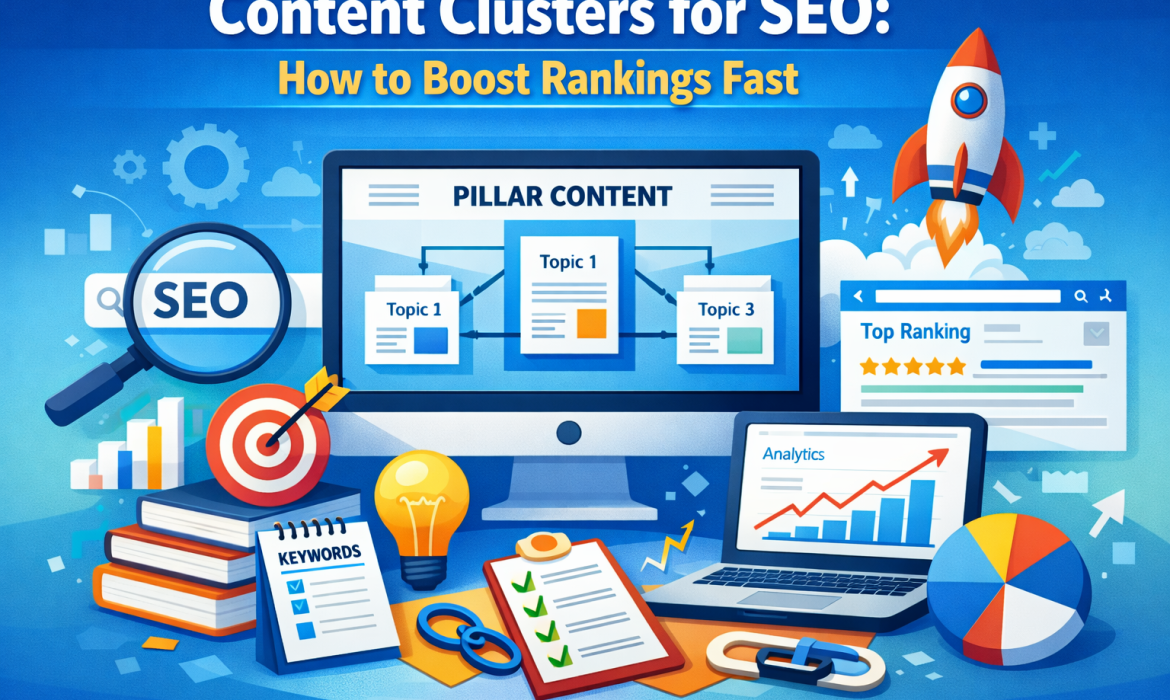
Many websites publish blogs every week. They expect search rankings to grow quickly. However, many blogs fail to attract steady organic traffic. The reason is simple. Many websites publish isolated articles without a clear strategy. Each post targets a different topic. Each post stands alone without connection to other content.
Search engines now evaluate websites differently. Google no longer ranks pages based only on individual keywords. Google now evaluates topic authority across an entire website.
Websites that cover a subject deeply gain stronger visibility. Websites that publish random articles often struggle to rank.
This shift changed modern SEO strategies. Marketers now focus on structured content systems instead of random blogging.
One powerful system is the content cluster model. This approach organizes articles around one main topic. Each article connects to related pages through internal links.
This structure helps search engines understand your expertise. It also helps readers explore information easily.
Businesses that implement content clusters often improve rankings faster. They also build long-term authority in search results.
The Core Idea Behind Content Clusters and Topical Authority
Content clusters organize multiple articles around a central topic. This structure signals strong subject expertise to search engines.
A content cluster contains three essential elements.
The first element is the pillar page.
The second element is supporting cluster articles.
The third element is internal linking.
The pillar page covers the main topic broadly. It introduces the subject and provides an overview.
Cluster articles explore smaller subtopics in greater detail. Each article answers specific questions related to the main subject.
Internal links connect all pages within the cluster. These links create a clear topic network.
Search engines analyze these connections carefully. They use them to understand the relationship between pages.
When multiple pages cover one subject thoroughly, search engines recognize strong topical authority.
This authority increases the chances of ranking for competitive keywords.
Websites that build strong topic clusters often outperform competitors who publish scattered articles.
How Content Clusters Help Search Engines Understand Your Website
Search engines constantly analyze how websites organize information. They look for signals that indicate expertise and structure.
Internal links play an important role in this analysis. They help search engines identify relationships between pages.
Content clusters create a clear hierarchy.
The pillar page acts as the central resource.
Cluster articles support the main topic.
Search engines recognize the pillar page as the primary authority page. They view supporting articles as detailed resources.
This hierarchy makes the website easier to understand.
Search engines also crawl clustered websites more efficiently. Clear linking structures guide search bots through related content.
Readers benefit from this structure as well. They can easily move between connected topics.
When visitors stay longer on a website search engines interpret this behavior as a positive signal.
These signals often contribute to improved search rankings.
Pillar Pages: The Foundation of Every Content Cluster Strategy
Every content cluster begins with a pillar page. The pillar page targets a broad topic that relates to your business or audience.
This page provides a comprehensive overview of the subject. It explains the key concepts and introduces related ideas.
A pillar page usually contains long form content. Many pillar pages exceed two thousand words.
The page should answer major questions about the topic. It should also guide readers toward more detailed articles.
These detailed articles form the supporting cluster content.
Think of the pillar page as a central hub of information. Supporting articles extend the knowledge beyond the main page.
For example consider a pillar page about content marketing.
Supporting cluster articles might include:
- Content marketing strategy
- Blog writing techniques
- Content promotion methods
- Content performance measurement
Each article explores one specific aspect of the topic.
The pillar page links to these articles. Each article also links back to the pillar page.
This linking system strengthens the topic network.
Building Supporting Content That Strengthens the Cluster
Supporting cluster articles form the backbone of the content cluster strategy.
Each article should focus on a single subtopic related to the main pillar page.
Cluster articles should answer specific search questions. They should also provide deeper explanations than the pillar page.
For example consider a pillar page focused on SEO strategy.
Cluster articles could include topics such as:
- Keyword research methods
- On page optimization techniques
- Link building strategies
- Technical SEO fundamentals
Each article targets a specific search intent. This improves the chances of ranking for long tail keywords.
Cluster articles must also connect through internal links.
Every cluster article should link back to the pillar page. This link signals that the pillar page remains the central authority.
Cluster articles may also link to other related articles.
This network creates a strong topic ecosystem. Readers can move between related subjects easily.
This behavior improves engagement and increases page views.
Search engines interpret this interaction as strong content relevance.
Step by Step Process to Create an Effective Content Cluster
Creating a content cluster requires planning and research. The process becomes easier when you follow a clear structure.
Step 1: Identify a Core Topic
Choose a broad topic that relates to your business. The topic should also match the interests of your target audience.
Examples include digital marketing. Content marketing. Search engine optimization.
Step 2: Research Supporting Keywords
Look for search queries related to the core topic. Keyword tools and search suggestions can help identify these ideas.
Group similar keywords into topic categories.
Each group can become a future cluster article.
Step 3: Build a Comprehensive Pillar Page
Create a detailed guide that explains the main topic clearly.
This page should introduce major concepts. It should also link to deeper supporting articles.
Step 4: Develop Supporting Cluster Articles
Write separate articles that explore each subtopic.
Each article should answer one specific question.
Focus on depth and clarity.
Step 5: Connect Everything Through Internal Links
Link the pillar page to every cluster article.
Link cluster articles back to the pillar page.
This linking system creates a structured content network.
Over time this structure strengthens your SEO authority.
Common Content Cluster Mistakes That Hurt SEO Performance
Many websites attempt content clusters but make critical mistakes.
One common mistake involves choosing topics that are too broad. Broad topics make clusters difficult to organize.
Another mistake involves weak internal linking. If cluster pages do not connect properly the structure loses effectiveness.
Some websites publish very short articles. Thin content provides little value to readers.
Search engines prefer detailed and helpful content.
Another mistake involves repeating similar information across articles. Duplicate ideas weaken the authority of each page.
Some websites ignore user search intent. They focus only on keywords instead of answering real questions.
Strong clusters solve real problems for readers.
Avoiding these mistakes helps the cluster strategy succeed.
Example of a Simple Content Cluster Structure
A simple example can help illustrate the concept.
Imagine a website that focuses on digital marketing.
The pillar page might cover the topic of digital marketing strategy.
This page introduces the major concepts of online marketing.
Supporting cluster articles might include topics such as:
- Content marketing strategy
- Email marketing fundamentals
- Social media marketing techniques
- Search engine optimization basics
Each article explores its topic in greater depth.
The pillar page links to every cluster article.
Each cluster article links back to the pillar page.
This structure creates a strong internal network.
Search engines easily recognize the main topic.
Readers can also explore related information without confusion.
Conclusion: Why Content Clusters Are Essential for Modern SEO
Search engine optimization continues to evolve. Random blogging strategies no longer deliver strong results.
Search engines now reward structured content systems. Content clusters provide one of the most effective systems available.
This approach organizes content around clear topics. Pillar pages introduce the subject broadly. Supporting articles explore detailed subtopics.
Internal links connect all pages within the cluster.
This structure helps search engines understand your website expertise. It also improves navigation for readers.
Businesses that adopt content clusters often see stronger rankings. They also experience steady growth in organic traffic.
If you want to improve your SEO results start building topic clusters today. Plan your pillar pages carefully. Create helpful supporting articles.
Connect your content through clear internal links.
Over time your website will build stronger authority and achieve higher search visibility.